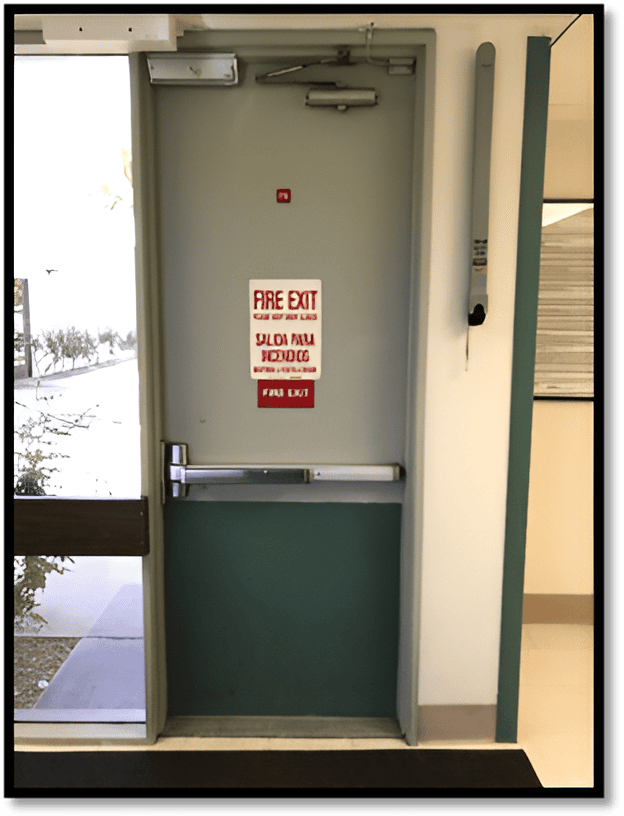
PM for Man Swing Doors + Fire
Fire door assemblies shall be visually inspected from both sides to assess the overall condition of door assembly.
As a minimum, the following items shall be verified:
-
No open holes or breaks exist in surfaces of either the door or frame.
-
Glazing, vision light frames, and glazing beads are intact and securely fastened in place, if so equipped.
-
The door, frame, hinges, hardware, and noncombustible threshold are secured, aligned, and in working order with no visible signs of damage.
-
No parts are missing or broken.
-
* Door clearances do not exceed clearances listed in 4.8.4 and 6.3.1.7.
-
The self-closing device is operational; that is, the active door completely closes when operated from the full open position.
-
If a coordinator is installed, the inactive leaf closes before the active leaf.
-
Latching hardware operates and secures the door when it is in the closed position.
-
Auxiliary hardware items that interfere or prohibit operation are not installed on the door or frame.
-
No field modifications to the door assembly have been performed that void the label.
-
Gasketing and edge seals, where required, are inspected to verify their presence and integrity.
Inspection shall include an operational test for automatic-closing doors and windows to verify that the assembly will close under fire conditions.
Assembly shall be reset after a successful test.
Resetting of the release mechanism shall be done in accordance with manufacturer’s instructions.
Hardware shall be examined, and inoperative hardware, parts, or other defects shall be replaced without delay.
Maintenance of Closing Mechanisms
Self-closing devices shall be kept in working condition at all times.
Swinging doors normally held in the open position and equipped with automatic-closing devices shall be operated at frequent intervals to ensure operation.
A written record shall be maintained and shall be made available to the AHJ.